
Alef (א) Explained: The Most Misunderstood Letter in Hebrew

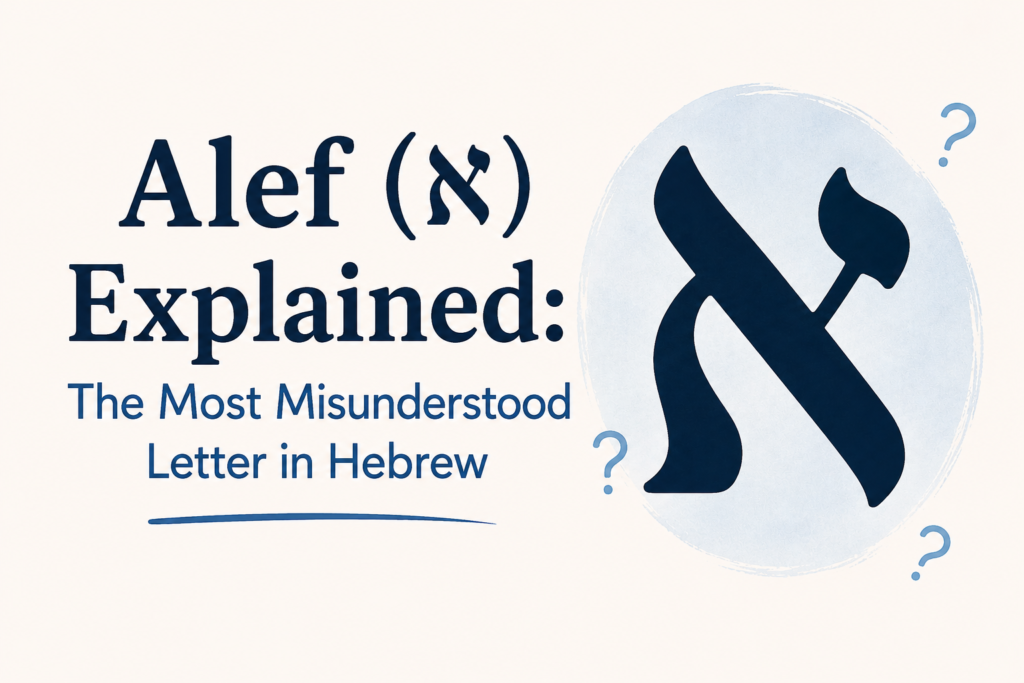
If you are starting Hebrew for the first time, one letter tends to confuse almost everyone: א (Alef).
It looks simple at first glance. Many learners assume it behaves like the letter “a” in English. That assumption feels natural, but it is also the main reason people struggle with it.
Here’s the truth: if you are thinking about א in any way like “a,” you’re doing it wrong.
They may be historically related, but the sound Alef makes has no real resemblance to the English “a.” This misunderstanding alone causes a lot of confusion, especially when you are trying to read, pronounce words or even learn basics like Hebrew language numbers.
What Alef (א) Really Means in Hebrew
Alef is not a vowel. It is a consonant first and foremost.
The sound it represents is a glottal stop.
If that sounds unfamiliar, think of the way certain British accents pronounce words like:
- “Water” → Wa’eh
- “British” → Bri’ish
That small pause in the middle is a glottal stop. That’s exactly what Alef does.
So instead of thinking of it as a vowel, think of it as a brief pause or break in sound.
When Alef Is Silent
Alef doesn’t always produce a noticeable sound. In many cases, it becomes silent.
This usually happens in places where pronouncing a glottal stop would feel unnatural, so the sound has faded over time.
When Alef is silent, it behaves like a “carrier” for the vowel before it. That means its pronunciation depends entirely on the preceding vowel.
For example, Alef can take different sounds depending on context:
- “o” as in לֹא
- “a” as in מָצַא
- “e” as in קוֹרֵא
- “i” as in רִאשׁוֹן
And in some cases, it doesn’t add any sound at all.
For instance, in words like הוא or לשווא, the Alef simply sits there without being pronounced.
This flexibility is what makes it feel unpredictable at first. But it follows consistent patterns once you understand the system.
The 3 Real Reasons Alef Feels So Confusing
Most of the difficulty with Alef comes from three very specific issues:
- English doesn’t treat the glottal stop as a real sound
In English, the glottal stop exists, but only by accident. It appears naturally in speech, especially before vowels, but isn’t treated as a separate sound.
Because of this, learners don’t recognize it when they see א. It feels unclear or invisible.
For example, in the word לֶאַט (le’at), the apostrophe marks the glottal stop. That’s where the Alef is, not in the surrounding vowel sounds.
- People are told to think of it like “a”
This is one of the most misleading ideas.
While Alef is historically related to the letter “a,” the sound it makes has nothing to do with it. Thinking of it this way leads learners to treat it like a vowel, which creates confusion later.
If you’re thinking of א as “a” in any way, you are approaching it incorrectly.
- Loan words create mixed signals
In some modern Hebrew words borrowed from English, Alef is used to represent vowel sounds. For example, גראס (grass).
This reinforces the idea that Alef behaves like a vowel, even though that’s not its original role in Hebrew.
Why Understanding Alef Matters Early
If Alef isn’t understood properly, small mistakes start to build up.
You may:
- Misread words
- Mispronounce basic vocabulary
- Struggle with sentence flow
This becomes especially noticeable when working through beginner topics like Hebrew language numbers or reading simple sentences.
The good news is that once you understand how Alef works, Hebrew starts to feel much more logical.
Instead of memorizing randomly, you begin recognizing patterns.
How Hebleo Teaches Alef Differently
This is where many learning methods fall short. They either oversimplify Alef or make it unnecessarily complex.
Hebleo takes a more practical and structured approach.
- Clear, accurate explanations
Instead of comparing Alef to English letters, it is taught as it actually functions in Hebrew. This removes confusion from the start.
- Learning in structured steps
Concepts are introduced gradually. You are not overwhelmed with too much information at once, which makes it easier to absorb and apply.
- Focus on real usage
You don’t just learn what Alef is. You see how it works in real words and sentences, supported by native speaker recordings and practical exercises.
- Avoiding unnecessary complexity
Rather than diving into overly detailed theory, the focus stays on what actually helps you read, understand and use Hebrew effectively.
A Better Way to Think About Alef
If you want a simple way to remember everything:
- Alef is a consonant, not a vowel
- Its main sound is a glottal stop
- It can sometimes be silent
- When silent, it follows the vowel before it
- It should not be compared to the English “a”
Once you shift your thinking, the confusion starts to disappear.
Final Thoughts
Alef is one of the most misunderstood parts of Hebrew, not because it’s difficult, but because it’s often explained incorrectly.
Once you understand that it’s a glottal stop, sometimes silent and not a vowel, everything becomes much clearer.
If this explanation helped you, the Hebleo Today online course goes much deeper into these concepts. It’s currently in early access and teaches Hebrew using an intuitive method developed through over 7 years of one-on-one tutoring, combined with a background in Cognitive Science.
The goal is simple: to make Hebrew feel logical, structured and easier to learn from the very beginning.



Responses